
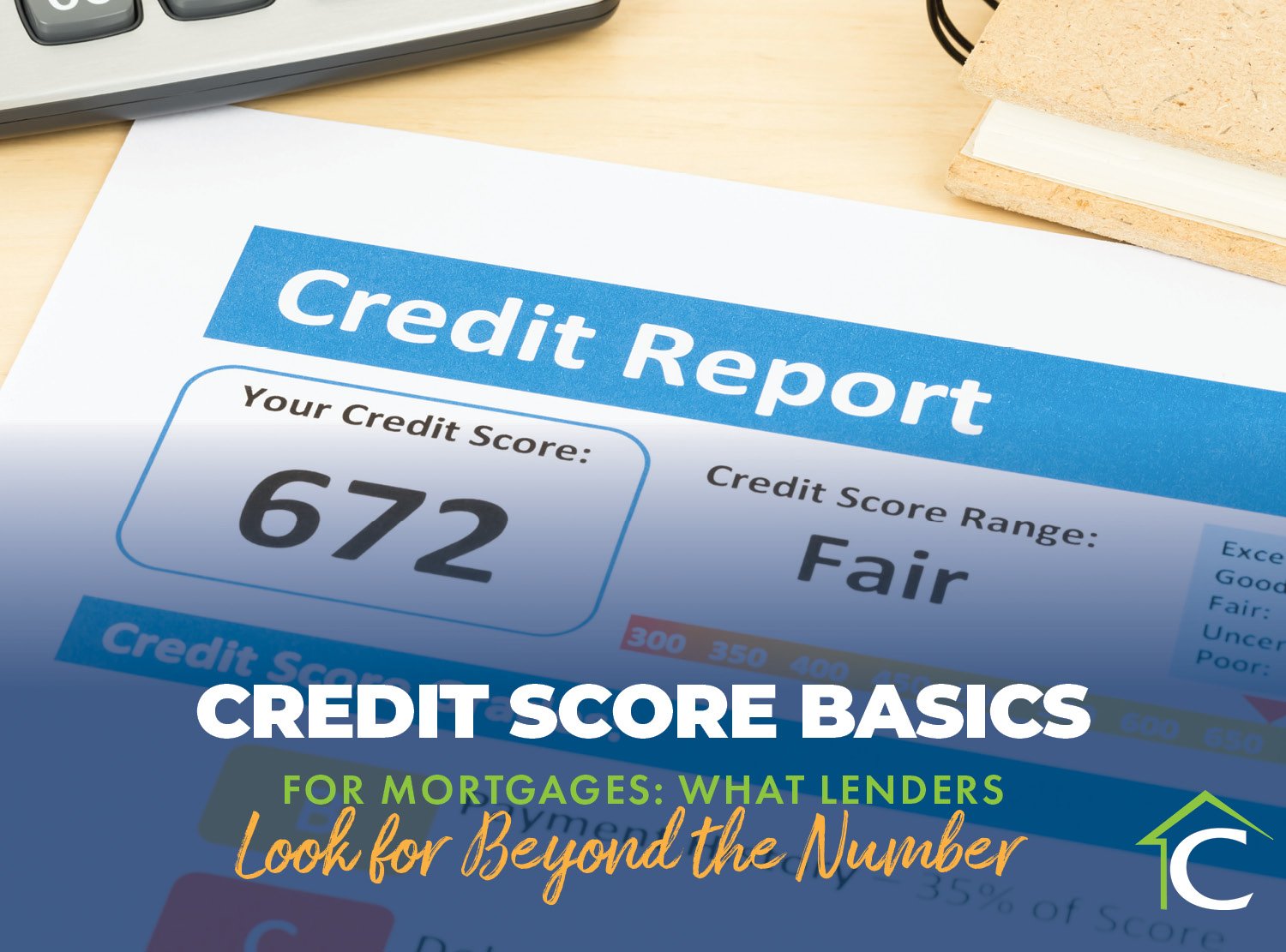
You check your credit score and see 680—right in the range many buyers need to move forward. That’s a solid starting point, but here’s the good news most homebuyers don’t hear when asking "What credit score do I need to buy a house?"
Mortgage approval isn’t decided by a single number.
Lenders look deeper—often in ways that work in your favor. Your credit report reveals payment consistency, how you manage balances over time, and whether past issues were temporary or truly resolved. In many cases, a borrower with a mid-600s score and strong recent habits can look more reliable than someone with a higher score but riskier patterns.
At Contour Mortgage, we’ve helped borrowers qualify by understanding—and highlighting—the strengths behind their credit profile. This guide breaks down which credit scores lenders actually use, how tri-merge reports work, and how compensating factors can strengthen your approval odds.
Key Takeaways
- Lenders use tri-merge credit reports: Your mortgage lender pulls reports from all three bureaus (Experian, TransUnion, Equifax) and typically uses your middle score, not the highest—meaning you need all three scores above the minimum threshold.
- Classic FICO models remain standard: Most lenders use FICO 2, 4, and 5 (not the VantageScore you see on Credit Karma), which can differ by 20-40 points from consumer-facing scores and explains why your "real" mortgage score might surprise you.
- Payment patterns matter more than isolated incidents: Lenders distinguish between a one-time late payment from three years ago versus a pattern of 30-day lates every few months—the story matters as much as the score.
- Recent credit behavior weighs heaviest: The past 12-24 months of your credit history receives the most scrutiny, making it critical to maintain perfect payment behavior once you decide to buy—even one late payment during this window can derail approval.
- Compensating factors can overcome score weaknesses: Large down payments, substantial cash reserves, low debt-to-income ratios, and stable employment can offset borderline credit scores or past credit issues.
- The full report reveals what the score hides: Underwriters see account-level details—utilization by card, payment history by account, inquiry reasons, and public records—that provide context the three-digit number can't convey.
What Credit Score Do You Need to Buy a House? Understanding the Tri-Merge Credit Report
When you apply for a mortgage, your lender pulls a tri-merge credit report that includes your complete credit file and scores from all three major credit bureaus: Experian, TransUnion, and Equifax. The minimum credit score to buy a house varies by loan type—ranging from 580 for FHA loans to 620+ for conventional loans—but understanding how lenders determine which score to use is critical.
For single borrowers: Lenders use your middle score. If your scores are 680 (Experian), 695 (TransUnion), and 670 (Equifax), your qualifying score is 680.
For co-borrowers: Lenders use the lower middle score between the two borrowers. If you have a 700 middle score and your spouse has a 660 middle score, the lender qualifies you at 660 for rate and program eligibility.
Your scores vary across bureaus because not all creditors report to all three bureaus, reporting timing differs, and each bureau may have slightly different information. This is why you should check all three reports before applying—errors on just one bureau can drag down your qualifying score even if the other two are excellent.
Which Credit Score Is Used for Mortgages? FICO Models Explained
Most mortgage lenders use Classic FICO models—specifically FICO 2 (Experian), FICO 4 (TransUnion), and FICO 5 (Equifax). These models were developed in the 1990s and remain the mortgage industry standard, which is why the credit score for mortgage approval often differs from what you see on consumer apps.
Why your Credit Karma score doesn't match
Credit Karma and most banking apps show you VantageScore 3.0 or newer FICO models. These scores can differ from your mortgage scores by 20-40 points because they weigh factors differently. Classic FICO penalizes recent late payments heavily and treats paid collections the same as unpaid collections. VantageScore gives less weight to paid collections, potentially showing you a higher score than mortgage lenders will see.
This explains the common scenario where borrowers say "but my app shows 720" and then discover their mortgage score is 680. It's not an error—it's simply different scoring models evaluating the same credit history.
For example, if you paid off a $800 medical collection last year, VantageScore 3.0 might give you credit for resolving it and show a 710 score. Classic FICO treats that paid collection the same as if it were still unpaid, resulting in a 680 score—the number your mortgage lender will actually use.
New scoring models on the horizon
VantageScore 4.0: Fannie Mae began accepting this model as an option (alongside Classic FICO) in November 2025. Lenders can now choose between scoring models on a loan-by-loan basis, though adoption remains in early stages as of January 2026.
FICO 10T: FHFA has validated this newer FICO model for future use by Fannie Mae and Freddie Mac and is working toward its adoption, including releasing historical performance data. FICO 10T uses ‘trended data’ that looks at roughly the past 24 months of credit behavior, which can benefit consumers who consistently pay down balances and disadvantage those whose debt levels are rising over time.
Current reality: As of January 2026, Classic FICO remains dominant. Most lenders continue using traditional models—don't assume newer models that might score you more favorably will be used.
What Lenders Look for Beyond Your Credit Score
Your credit report tells a detailed story that matters as much as the three-digit number. Here's what underwriters scrutinize when evaluating your mortgage application:
Payment history patterns
What matters most: The pattern and recency of late payments. An isolated 30-day late payment from four years ago during documented hardship (job loss, medical emergency) is very different from multiple 30-day lates over the past 18 months.
Red flags: Recent patterns suggesting ongoing financial stress, late mortgage/rent payments (treated more seriously than credit cards), late payments during the application period.
For homebuyers: If you have late payments, prepare written explanations with documentation. The Consumer Financial Protection Bureau confirms you have the right to add explanatory statements to your credit file.
Credit utilization & account management
Underwriters look beyond overall utilization to individual account patterns. Maxing out one card while keeping others at zero signals different management than spreading utilization evenly.
Concerning patterns:
- Consistently maxed-out cards (even with on-time payments)
- Recent sharp increases in balances
- Cash advance activity
- Multiple balance transfers
Positive patterns:
- Low utilization across all accounts (under 30%, ideally under 10%)
- Stable or decreasing balances over time
- Available credit that's unused
Public records & collections
Bankruptcies, foreclosures, judgments, and collection accounts appear with dates and amounts. Per the Fair Credit Reporting Act, most negative items remain on your report for seven years, but their impact diminishes over time with re-established positive credit.
Bankruptcy waiting periods:
- Chapter 7: FHA allows approval two years after discharge; conventional typically requires four years
- Chapter 13: FHA allows approval one year into payment plan; conventional typically requires two years after discharge
Collections: Medical collections under $2,000 are excluded from debt-to-income calculations per Fannie Mae/Freddie Mac guidelines, though collection accounts still appear on credit reports. Non-medical collections may need to be paid or have payment plans established before closing, depending on loan program and lender requirements.
Key insight: Documented hardship (job loss, medical emergency, divorce) with subsequent re-establishment of credit receives more favorable treatment than patterns suggesting ongoing financial problems.
Credit Score Requirements by Loan Type: Minimums & Lender Overlays
Understanding what credit score is needed to buy a house depends on which loan program you're using:
|
Loan Type |
Official Minimum |
Typical Lender Requirement |
Why the Gap Exists |
|
FHA Loans |
580 (3.5% down), 500 (10% down) |
620-640 |
Lenders add overlays; FHA participation is voluntary |
|
Conventional Loans |
None (DU automated)* |
620+ |
Despite November 2025 policy change, lenders maintain overlays |
|
VA Loans |
None |
620+ |
VA sets no minimum; lenders establish requirements |
|
USDA Loans |
None |
640+ |
USDA's automated system requires 640 for approval |
Overlays are additional requirements lenders add beyond government minimums to manage risk. Different lenders have different overlays—if one declines you, another might approve you with the same profile. This is why shopping around matters when your score is near minimum thresholds.
Ready to explore which loan programs match your situation? Learn more about FHA loan requirements.
Compensating Factors That Overcome Credit Weaknesses
Strong compensating factors can offset borderline credit scores or past credit issues:
Large down payment (20%+ equity): Dramatically reduces lender risk. A 640 score with 25% down may receive approval, where 640 with 5% down would be declined.
Substantial cash reserves: Having six to 12 months of housing payments in liquid reserves strengthens applications with borderline credit. Counts savings, checking, money market accounts, stocks/bonds, some retirement accounts.
Low debt-to-income ratio: DTI under 36% is excellent. Lower DTI can offset credit scores at minimum thresholds, limited credit history, or self-employment income challenges.
Stable employment history: Two+ years in the same field demonstrates income reliability. Solid employment history can offset credit scores at program minimums or higher debt-to-income ratios.
Now that you understand what lenders evaluate beyond your credit score, see where your profile stands with our interactive assessment below. This tool compares your inputs against common lender guidelines to help you understand your readiness for mortgage approval.
Readiness Assessment
Compare your profile against common lender guidelines.
How to Improve Your Credit Score for a Mortgage: Strategic Timeline
6-12 months before applying
Months 12 before:
- Pull all three credit reports from AnnualCreditReport.com
- Dispute errors or unrecognized accounts
- Stop opening new credit accounts
Months 6-9:
- Pay down credit card balances below 30%, ideally below 10%
- Set up autopay for minimum payments on all accounts
- Build cash reserves alongside debt paydown
- Pay off or settle collection accounts
Months 3-6:
- Achieve target utilization ratios
- Stop making major purchases or financial changes
- Gather documentation for negative items requiring explanation
Months 1-3:
- Pull updated reports to verify improvements
- Connect with lenders for pre-approval
- Avoid changes to credit, employment, or financial accounts
During the mortgage process: Critical rules
Once you've applied, your financial status essentially freezes. Any changes can delay or derail approval.
Never do these after applying:
- Open new credit cards (even store cards)
- Take new auto loans or personal loans
- Co-sign on anyone's loans
- Make large credit card purchases
- Change jobs or careers
- Move large sums between accounts without documentation
- Pay off collections without consulting your loan officer
Lenders pull credit multiple times and right before closing. New accounts, debt, or financial changes can void your approval even days before closing.
Getting Help With Complex Credit Situations
Some scenarios benefit from professional guidance:
- Credit scores near minimum thresholds (580-640)
- Recent negative credit events (bankruptcies, foreclosures, late payments)
- Self-employment or complex income (typically requires 660+ even for FHA)
- Thin credit files or limited history
- Multiple credit profiles to optimize when co-borrowing
With more than 30 years of experience and nearly 500 mortgage professionals nationwide, Contour Mortgage guides homebuyers through complex credit scenarios. We review your complete credit picture, explain what lenders will see, and position your application strategically. We work with multiple investors and programs, matching your specific situation with the right loan product.
Most importantly, we're transparent about timing. If your credit needs improvement before applying, we tell you exactly what to focus on and how long it will take—because we'd rather set you up for success than push you into a denied application.
Frequently Asked Questions About Credit Scores for Mortgages
What credit score do I need to buy a house?
The minimum credit score to buy a house is 580 for FHA loans (or 500 with 10% down), though most lenders require 620-640 in practice. Conventional loans typically require 620+, while VA loans generally need 620 despite having no official minimum. USDA loans require 640 for automated approval. However, meeting these minimums doesn't guarantee approval—lenders evaluate your complete financial profile including income, debt-to-income ratio, employment history, and cash reserves.
Why is my mortgage credit score lower than Credit Karma shows?
Credit Karma shows VantageScore 3.0, while most mortgage lenders use Classic FICO models (FICO 2, 4, 5). These scoring models weigh factors differently—Classic FICO treats paid and unpaid collections the same, while VantageScore gives less weight to paid collections. Differences of 20-40 points are common and normal. Check your actual FICO scores through MyFICO.com before applying to avoid surprises.
How long after bankruptcy can I get a mortgage?
FHA loans: Chapter 7 bankruptcy—two years after discharge with documented hardship; Chapter 13—one year into payment plan with court approval.
Conventional loans: Chapter 7—typically four years; Chapter 13—typically two years after discharge.
"Documented hardship" means showing the bankruptcy resulted from circumstances beyond your control (job loss, medical emergency, divorce). You must demonstrate re-established positive credit patterns since the event. Learn more about FHA loan requirements.
Taking the Next Step: Understanding Where You Stand
The gap between your credit score and your credit story matters. A 680 score with perfect payment history, low utilization, and stable employment tells lenders you're a strong candidate. A 680 score with maxed cards and recent late payments raises concerns—regardless of meeting the minimum threshold.
Ready to understand what lenders will see when they evaluate your credit—and how to position your application for success?
Our experienced loan officers will review your tri-merge credit report, explain exactly what underwriters will focus on, identify items requiring explanation or correction, and provide a strategic action plan—whether that's applying now or spending three to six months optimizing your credit first.
Whether you're exploring conventional loan programs, FHA financing options, or VA loan benefits, we'll match you with the right program for your specific credit profile.